
From the pages of Texas Forestry magazine’s JULY/AUGUST issue
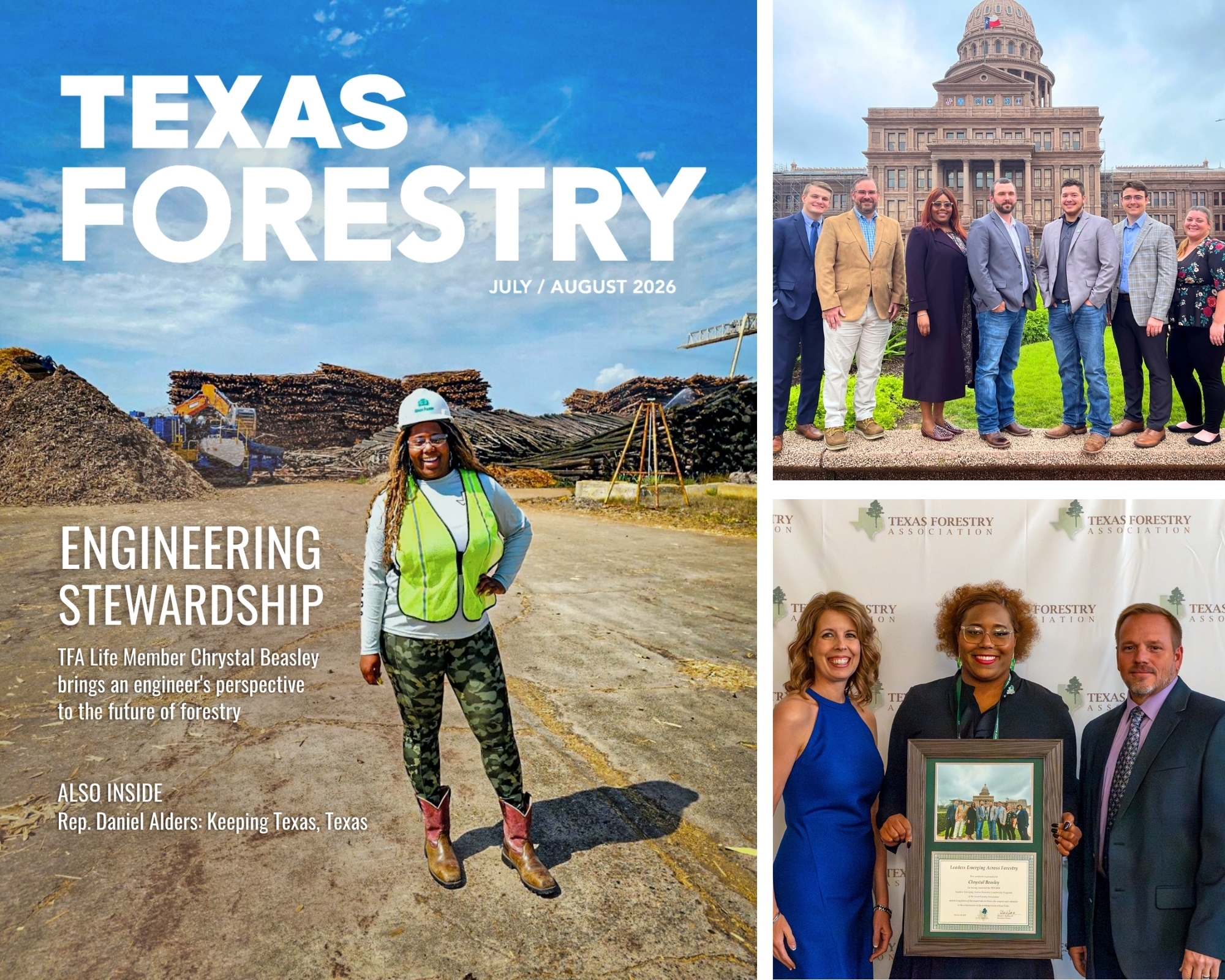
LIFE MEMBER SPOTLIGHT: Chrystal Beasley
An engineer’s approach to stewardship
When Chrystal Beasley returned to her family forestland in Marshall, Texas, after her first year of trial-and-error beekeeping, she wasn’t expecting much. The year prior, a hot Texas summer had wiped out every single hive, leaving her wondering if the operation should simply stick to forestry. But when she opened the boxes that spring, they were filled with bees and honey. For Chrystal, it felt like an unexpected sign.
“Things like that just kind of give indicators,” she said. “Like somebody still wants me to be here, working this land.”
But Chrystal’s connection to the land is only part of her story. The other is a career shaped by a habit of looking for solutions. Together, those two worlds have shaped an approach grounded in both technical expertise and stewardship.
AN ENGINEER’S PERSPECTIVE
Chrystal’s career has taken her through private industry, state government, and federal agencies, giving her insight into every stage of the regulatory process.
Those experiences eventually led her to launch BeAspire Enviro Consulting, where she provides regulatory advisory, compliance audits, and sustainability consulting to clients navigating complex environmental requirements.
When Chrystal became more involved in managing her family’s timberland, she found herself looking at the property through the lens of an environmental engineer. As she learned about carbon sequestration and emerging environmental markets, she became interested in the opportunities and challenges they presented for landowners. Today, she is focused on identifying ways to incorporate her environmental engineering experience into the carbon marketplace, a shift in perspective that continues to shape her work.
LOOKING BEYOND THE TREES
To Chrystal, forestry is about more than growing trees and waiting for harvest. Wildlife habitat, recreation, conservation initiatives, and emerging environmental markets are all ways to enhance land value and provide revenue over time. That way of thinking eventually led her to take a closer look at what today’s carbon markets have to offer.
“Right now, I’m trying to come up with solutions to solve landowner issues on the carbon sequestration side,” she said. “I’m figuring out a way to tie it into waste reduction, coming up with a program and a process that can benefit forest landowners in an incentivized manner.”
While she doesn’t get into details, she is optimistic about where that work may lead.
“I’m building something, and if it goes the way I hope it will, it’s going to be awesome.”
KEEPING THE LEGACY ALIVE
Chrystal’s connection to the land runs deep. Her family’s forestland has been passed down through generations since 1878, when her great-grandmother received the property from her own grandfather.
To honor the women who came before them, Chrystal and her cousins stepped into a more active role in managing the land. Together, they created MAViAN Farms, building on a forestry legacy that had existed for generations.
Though her great-grandparents managed both timber and cattle, she needed an operation that fit her limited availability. Living in Houston and running a consulting business full time made cattle impractical, but bees offered a different way to remain connected to the land.
While the hives produce honey, her focus is ecological rather than commercial. She saw beekeeping as a way to support pollinator populations and strengthen the local ecosystem while keeping the property active.
For Chrystal, stewardship is about more than managing trees or maintaining family property — it is a way of staying connected to the land, the people who came before her, and the legacy they left behind.
ADD IT ALL UP
When deciding to become a Texas Forestry Association Life Member, Chrystal approached it much like she approaches her work: practically.
“I think I had already been a member for maybe about five years. I mean, the math is the math,” she said with a laugh.
But she was quick to point out that the value of membership in the association extended far beyond the numbers.
Early on, the forestry side of the business came with a learning curve, so she set out to get a better handle on the field. That desire to learn eventually led her to participate in the association’s inaugural Leaders Emerging Across Forestry (LEAF) program. Through the program, she gained a deeper understanding of the forestry industry while building relationships with people across the entire forestry sector.
The education, relationships, and professional network she gained through TFA and the LEAF program continue to benefit her long after the classes ended.
BUILDING FOR THE FUTURE
For Chrystal, engineering and stewardship are not separate parts of her life. They are two sides of the same philosophy.
Whether she’s exploring new opportunities for landowners, advising clients, or caring for family land, she continues to apply the same problem-solving mindset that has guided much of her career. Understanding what exists today while looking for ways to improve what comes next.
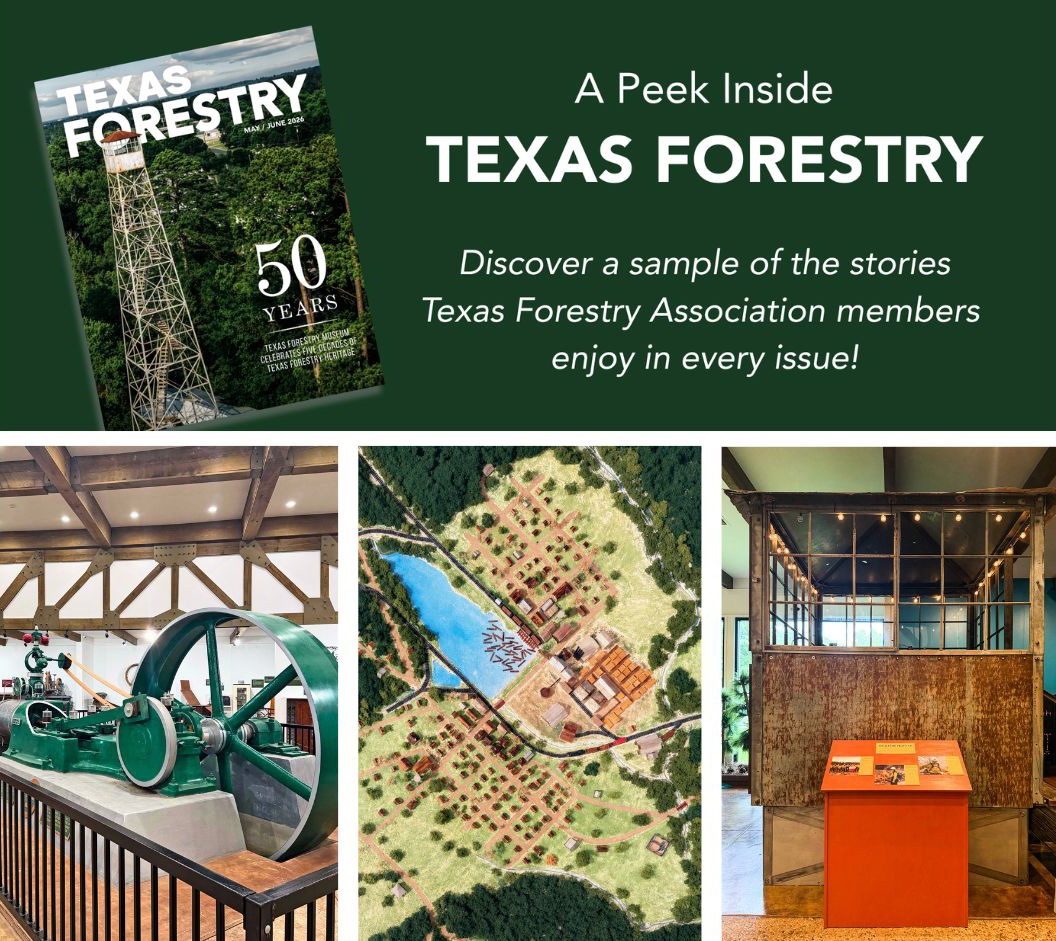
From the pages of Texas Forestry magazine’s MAY/JUNE issue
Texas Forestry Museum:Where East Texas Forestry Stories Still Live
As the lunch hour broke in the Pineywoods a century ago, a signal echoed across the treetops. It wasn’t just a standard shift marker. It was the “cornbread whistle,” a high-pitched note blown from the sawmills to let women know it was time to pull skillet bread from the oven before their husbands returned from the woods.
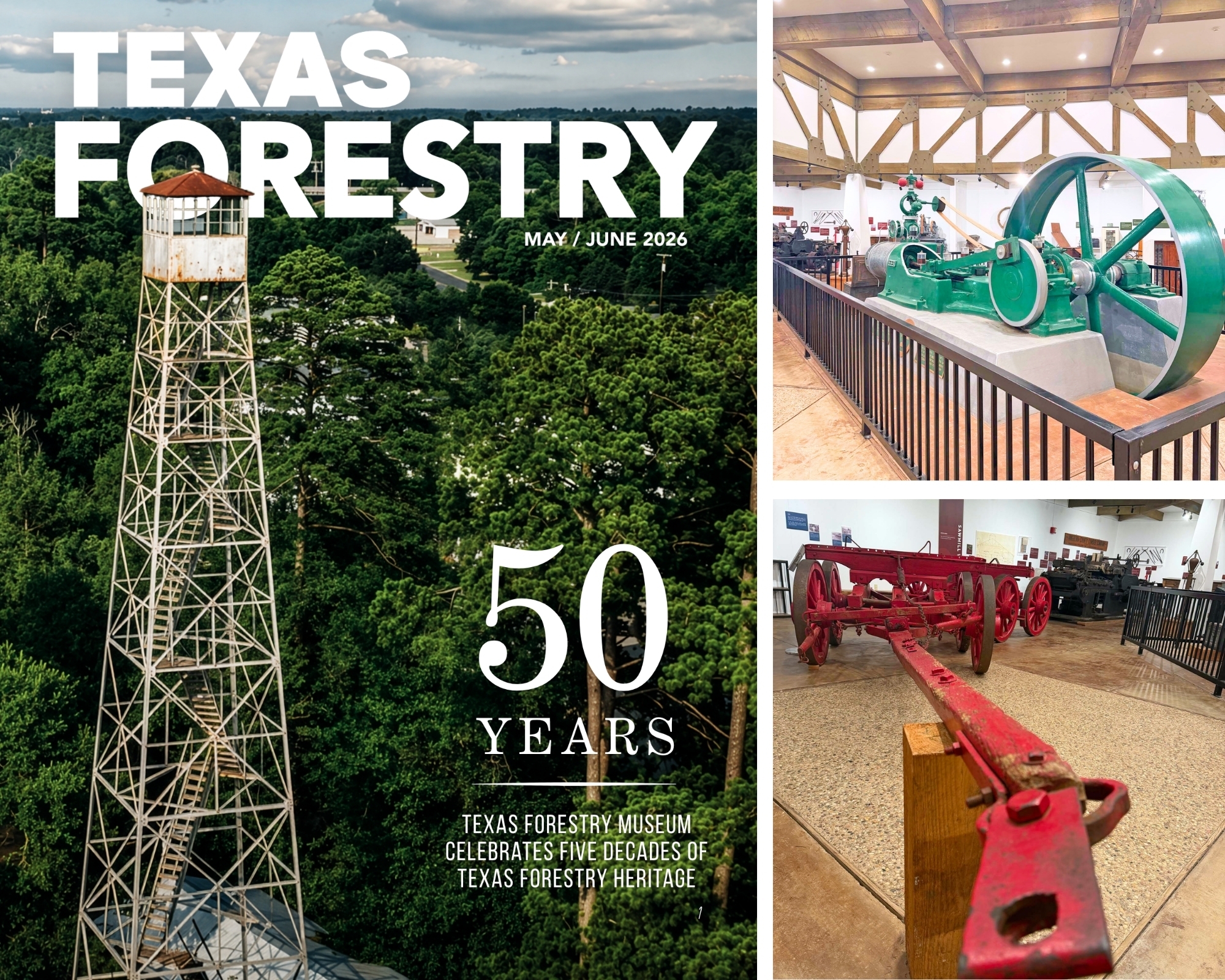
Today, you can still experience this slice of daily life at the Texas Forestry Museum in Lufkin. Here, visitors explore old commissary punch cards, historic photographs and even the real mill whistles that once set the pace for entire towns.
As the museum celebrates its 50th anniversary, it offers a doorway back to a different time. One where East Texas revolved entirely around timber.
Stepping Into the Timeline
What makes this museum so special is that it doesn’t just ask you to read history on a plaque. It invites you to step right into it.
The journey kicks off with a walk through the deep roots of the region, charting a timeline that stretches from the early Caddo farming communities of 800 C.E. all the way through major Texas milestones like Juneteenth in 1865.
But the energy really picks up when you hit the explosive lumber boom era. In the Virgin Timber gallery, the walls are lined with striking, large-format historic photographs that instantly put the scale of the old woods into perspective. In one favorite exhibit panel from 1908, loggers J.W. Getsinger and J.T. Gillespie pose proudly beside a massive virgin pine harvested for the Thompson Brothers lumber company in Doucette, Texas. The exhibit asks a question that stops both kids and adults in their tracks: Can you imagine cutting down these giant trees with only a crosscut saw and an ax?
Next to those photos, you can see the actual tools of the trade used by early “flatheads,” including manual crosscut saws used by the Thompson & Tucker Lumber Co. crews in Willard, Texas, which crews operated entirely by hand.
From the Woods to the Model Town
The museum makes it easy to see how hard work and new technology transformed the timber industry. You can follow the boom-era story by walking among the giant machines: check out the old high-wheel carts that oxen once pulled and see how steam skidders with heavy winches eventually took over, hauling timber out of the woods and onto waiting trains.
The exhibits also show how closely many East Texas communities were tied to the timber industry.
One of the museum’s most detailed displays is a scale model of the Carter-Kelly Lumber Co. townsite in Manning, Texas, depicting the community as it appeared in 1928. Built by Robert L. Flournoy in memory of Morgan M. Flournoy, superintendent of Manning School, the model gives visitors a bird’s‑eye view of the homes, rail lines, mill operations and layout of a sawmill town during the height of East Texas’ lumber era.
A Turning Point for Forestry
The story doesn’t stop indoors. It continues outside, where you’ll learn about a major turning point for the industry. By the mid-20th century, most of the virgin timber was largely gone and devastating wildfires frequently swept across the cutover lands.
Out on the museum grounds, you can look up at a historic fire tower, the main line of defense against wildfires from the 1920s through the 1970s. This tower marks the moment when East Texas forestry shifted from pure extraction to active conservation, fire prevention and replanting. Nearby, interactive displays and hands-on activities help connect younger visitors to modern forestry careers, showing how the industry continues to evolve.
A Living Legacy for the Forestry Family
What keeps the Texas Forestry Museum from feeling like just a collection of old machines is how personal the experience is for everyone who visits.
Even after fifty years, the museum is much more than just an archive. For many East Texans, a walk through the exhibits sparks a sudden memory, like spotting a grandfather’s name on an old roster or recognizing a familiar face in a faded photograph of a logging crew. For some visitors, the museum offers a personal connection to East Texas forestry history, a reminder of the families, communities and forests that helped shape the region.
So, whether you’re searching for a piece of your own history or simply a bit of wonder beneath the pines, the Texas Forestry Museum is waiting to welcome you home.